Burnout plagues about 40% of respondents, CBC survey suggests
 Nearly a quarter of nurses wouldn’t recommend the hospital where they work to their family or friends, a survey by CBC News has found.
The startling figure comes from an online survey that CBC’s flagship investigative show, the fifth estate, distributed to registered nurses across the country as part of Rate My Hospital, a sweeping series about health care that continues all week.
Twenty-four per cent of respondents to the survey distributed through nursing associations and unions said they definitely would not or probably would not recommend their hospital to loved ones.
“I’m very disappointed that nurses can’t recommend their facilities, the places where they work, to their loved ones,” said Ontario Nurses’ Association vice-president Andy Summers. “When they look around them and they realize that they couldn’t recommend that facility, it tells me that they’re recognizing how dire their practice is.”
More than 4,500 registered nurses from at least 257 hospitals responded to the survey asking about how nurses felt on a range of topics from hospital resources to quality of care.
Registered nurses in Newfoundland and Labrador, Ontario and British Columbia were the least likely to recommend the hospitals where they work, while those in Prince Edward Island, Nova Scotia and Alberta were the most likely to do so. Few nurses responded from Manitoba, Quebec and the northern territories.
Staffing levels ‘worrisome’
About 60 per cent of nurses responding to the CBC online survey said there was not enough staff for them to properly do their jobs.
Judith Ritchie, associate director for nursing research at the McGill University Health Centre, said that high percentage is worrisome not only for nurses but also for patients.
“There is clear, clear evidence that short staffing has negative impact on patient outcomes, as well as nurses’ health,” warned Ritchie, whom CBC consulted with to develop the survey questions.
Linda Silas, president of the Canadian Federation of Nurses Unions, said staffing levels are the No. 1 issue across the country for nurses.
“Just recently I met a new graduating class of nurses — 125 of them — and none of them had jobs,” said Silas. “I just had to shake my head because we know the system is short. We’re working on overtime. That’s what’s keeping our system alive.”
A report by the Canadian Institute of Health Information released earlier this year found that the number of nurses in Canada had risen by the end of 2011, but nursing organizations say distribution is patchy across the country and the ratio of registered nurses to population still lags in some areas.
Summers said that in Ontario, which has the second worst population-to-registered nurse ratios, about 300 nurses have been laid off in the past four months.
Belt-tightening in many parts of the country has not only led to layoffs, but also cost-cutting measures such as not bringing in replacement nurses for those who call in sick, nurses told the CBC.
“I work in cardiac surgery, and they tried to save budget so they’re not replacing for sick call,” said one Toronto-area nurse who asked that her identity be protected for fear of reprisal. “So, it just puts the patients at risk. The hospital, they’re in denial.”
Another nurse who works at a busy Ontario hospital says her unit successfully fought against staffing shortages caused by cutbacks, but the constant battles take a toll.
“It’s just hard to be passionate: how do you keep the passion when you feel like you’re fighting upstream?” said the nurse, who also asked not to be identified.
‘Everybody’s burned out all day’
Constant short-staffing can lead nurses to burn out — a state that nearly 40 per cent of respondents said they suffered from to a high degree.
A part-time registered nurse who has worked at a rural Newfoundland hospital for more than 25 years said that recently burnout is plaguing members of her unit on a daily basis.
“Everybody’s burned out all day. And you just pray that you can get through the day, every day and everyone will get through the day safely with you,” said the nurse, who also asked that her identity be protected.
“There’s times I would just say, ‘It’s only by the luck of God we got through this day and nothing happened.'”
Not only does nurse burnout cost the system in sick leave and lead to the loss of skilled workers, it can also harm patients, says Ritchie, because the nurse becomes disassociated from her job.
“If you’re not really looking at the patient, and you’re not really listening because you just can’t or you will lose it, then you’re going to miss important cues, and nurses are the patients’ safety nets,” said Ritchie. “They’re their first line of defence.”
Quality of care questioned
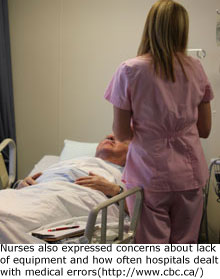 However, the majority of respondents — 88 per cent — said patient safety in their unit or work area of the hospital is acceptable or better, while 11.5 per cent gave their facility a poor or failing grade.
Despite that, nearly 40 per cent said they didn’t feel as if they could do their job to a quality standard that they were pleased with.
Those findings echo a frustration that the rural Newfoundland and Labrador nurse says she’s often felt in recent years.
“I can’t do, truly do, for my patients what I want to do and they need,” said the nurse, who asked not to be identified.
For Kamloops, B.C., nurse Aki Minato, delivering quality care is a key reason she chose the job. She’s among the 46 per cent who feel satisfied with the quality they deliver.
“I’m just grateful that I have this job, that I do what I believe is valuable work, and the patients are so grateful, and I feel that every day I work,” says Minato, who works in a dialysis unit.
Among the other issues nurses expressed in the survey were the lack of necessary equipment to do the job and frustration that medical errors weren’t always addressed.
Equipment woes
Forty per cent of respondents worry that when errors happen in their hospital, action is taken only in half the cases or less.
“I think that lots of time, [the errors] might be ignored or [the hospital] waits for something big to happen [before taking action],” said one Toronto-area nurse who asked not to be identified.
Lacking the supplies, materials and equipment necessary to do their job was also an issue for 36 per cent of respondents.
Ritchie says that’s a common complaint, in part caused by a hospital funding structure dependent on donations.
“Often, the equipment is purchased based on donations, like a big MRI machine or something fancy. But it’s not very prestigious to say I donated 150 special pumps for intravenous or feedings,” said Ritchie.
Nearly six per cent of nurses who answered the survey reported that they sometimes don’t even have the basic hygiene necessities of hot water, soap, paper towels or alcohol rubs available when needed.
More than 360,000 regulated nurses work in Canada, making them one-third of the national health-care workforce.
The Canadian Federation of Nurses Unions president says it’s time to address the problems facing nurses across the country.
“Nursing is the No. 1 area to address,” said Silas. “After you fix nursing, you’ll fix the rest.”
Source: cbc.ca



 Jakarta – Kementerian Kesehatan telah mengirimkan surat edaran kepada Dinas Kesehatan di seluruh daerah dan rumah sakit (RS) pemerintah untuk meningkatkan kewaspadaan terhadap Influenza Like Illness (ILI) dan Severe Acute Respiratory Infection (SARI) yang mungkin ditemukan.
 Jakarta, PKMK. Penerapan telemedicine di Indonesia terhambat oleh sejumlah faktor. Satu di antaranya adalah biaya penyelenggaran infrastruktur teknologi informasi yang masih mahal. dr. Erik Tapan, MHA, pengamat informatika kedokteran, mengatakan hal tersebut di Jakarta hari ini. Erik menyampaikan dengan infrastruktur teknologi informasi yang masih mahal, telemedicine Indonesia menjadi tidak feasible untuk dipasarkan. “Bandwidth di Indonesia itu kan terbilang mahal,” kata dia. Kecepatan perkembangan telemedicine di Indonesia, ia mengatakan, akan sejajar dengan harga infrastruktur teknologi informasi. Semakin menurun harga tersebut, semakin cepat pula perkembangan telemedicine.
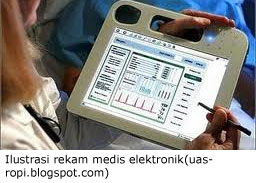 Jakarta, PKMK. Penerapan sistem rekam medis elektronik di rumah sakit seluruh Indonesia sudah lebih berkembang daripada sebelumnya. Meskipun seperti itu, dapat dikatakan bahwa rumah sakit yang menggunakan rekam medis elektronik standar internasional masih sedikit jumlahnya. Dengan demikian, rekam medis elektronik itu belum memungkinkan adanya komunikasi internasional. hal ini diungkapkan Prof. Johan Harlan, Kepala Pusat Studi Informatika Kedokteran Universitas Gunadarma di Jakarta (8/4/2013).
 Sebagai ilustrasinya, bagaimana ekspresi seorang pasien yang menjalani pemeriksaan penyakitnya di salah satu ruangan di hotel yang menyediakan klinik, sementara dokternya berpakaian bebas. Tentu ketegangan psikisnya tidak akan separah di rumah sakit untuk urusan yang sama. Ini contoh vulgar pengaruh asesoris rumah sakit terhadap psikologis pasien.
 MEDAN-Dokter spesialis dan konsultan penyakit tropik dan infeksi, Dr Umar Zein SpPD, KPTI memperkirakan, 10 persen pasien yang dirawat di Rumah Sakit (RS), khususnya pasien pasca operasi yang memakai alat seperti kateter, infus, selang untuk makan dan di ruang ICU rentan terkena infeksi nosokomial.